Guide
Capo Types: A Plain Guide to Every Kind of Guitar Capo
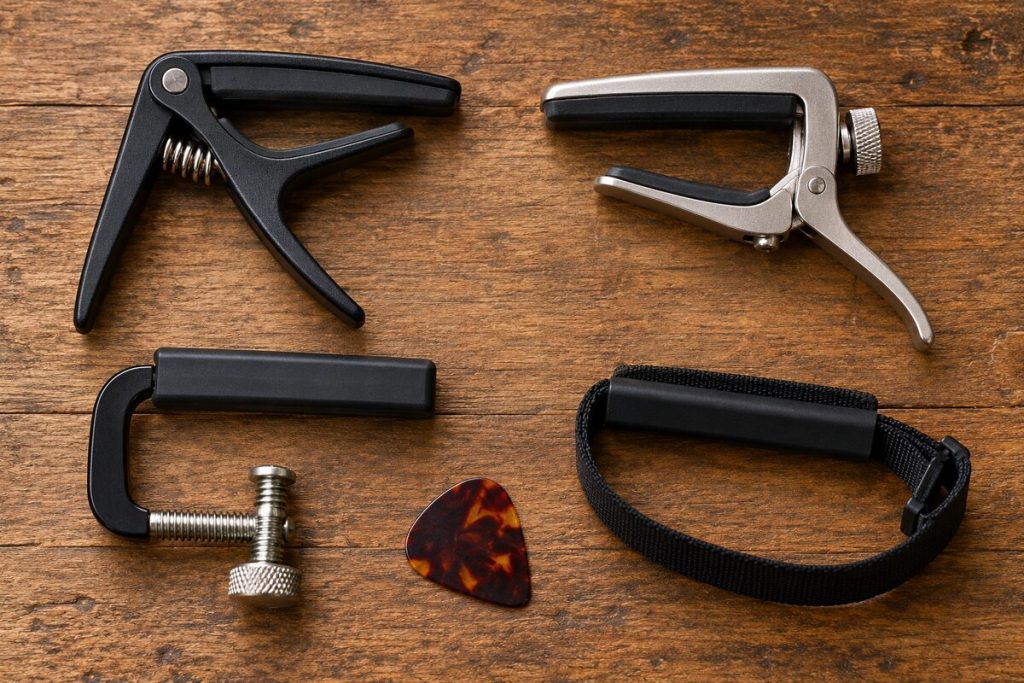
The main capo types are trigger (spring clamp) capos, screw or adjustable capos, toggle and elastic capos, partial and spider capos, rolling capos, and capos built for banjo, ukulele and mandolin. They all do the same job: press the strings against the fretboard so you can change key without changing chord shapes. They differ in how they clamp, how fast they move, and how much control you get over pressure and string coverage.
This guide walks through each type, what it is good at, and where it falls short, so you can pick one that matches how you actually play. If the whole idea is new to you, start with what a capo does and come back.
Trigger (spring clamp) capos
A trigger capo is the one most players picture. A spring holds a padded bar against the strings, and you squeeze a trigger or lever to open the jaws. Release it and the capo snaps shut on the neck. You will also see it called a spring clamp capo or a quick-release capo.
Why players like them
Speed is the whole point. You can put a trigger capo on with one hand, move it up or down the neck between songs, and take it off in a second. That matters on stage, and it matters at a kitchen table when you keep changing keys to find a comfortable range for a singer.
The trade-off
The spring sets the pressure, and you cannot tune it. On a neck that suits the clamp, that is fine. On a neck with an unusual width or curve, the clamp can pull a string sharp or leave one buzzing, and you have nothing to adjust. Check your tuning every time you move it.
Browse ours
Our Trigger Capo PLUS is a metal trigger capo for acoustic and electric guitar. If you want the simplest version of the idea, the basic spring clamp capo is the place to start.
Screw and adjustable capos
A screw capo uses a threaded knob to tighten the bar against the strings. Because you turn the screw to set the grip, you decide how hard it presses. Players also call these adjustable capos, and “screw capo” is a common search for exactly this style.
Where they shine
Control. If your neck is narrow, wide, flat or curved, you can tighten just enough to stop buzz without bending notes sharp. Players who care about intonation, or who move between several guitars, often prefer this type for that reason.
Where they cost you
Time. Turning a screw is slower than squeezing a trigger, so these suit setups where you place the capo once and leave it for a whole song or set. Over-tightening is the usual mistake: stop as soon as the strings ring clean.
Browse ours
If fine control sounds like you, look through our adjustable capos.
Toggle and elastic capos
A toggle capo uses a lever or cam that you flip over to lock the bar in place. An elastic capo is a strap, usually fabric or rubber, that wraps around the neck with a bar or pad pressing on the strings. Both are simple and light.
Good for
A spare in the gig bag, or a beginner who is not sure how much they will use a capo. They keep things uncomplicated, and there is little to learn.
Watch out for
Consistency. A toggle depends on how the cam is set, and an elastic strap can stretch and lose grip over time, which is when strings start to buzz or go flat on one side. We do not have a toggle or elastic category in the shop right now, so treat this section as buying advice only.
Partial and spider capos
Standard capos cover all six strings. Partial capos cover only some of them, which leaves other strings open. Players use them to get open-tuning sounds and drone-like effects without retuning the guitar.
Partial capos
A partial capo presses some of the strings and leaves the rest ringing open. It lets you get an alternate-tuning sound in seconds, and it changes how familiar chord shapes sound. For most players it is a color to reach for in a particular song, not a daily driver. Browse our partial capos.
Spider capos
A spider capo has individual fingers, and each one presses a single string. You choose which strings are held down and which stay open, which opens up voicings that would be awkward or impossible with a regular capo. Fingerstyle players tend to like them. The cost is setup time: you adjust each finger and recheck how every string sounds. See our spider capos.
Rolling capos
A rolling capo has a bar that rolls along the strings, so you can slide it up or down the neck without lifting it off. The idea is to change position in the middle of a song. In practice you give up some pressure control and a secure fit for that convenience, so it stays a specialist tool.
Capos for other instruments
Guitar capos are sized and shaped for a guitar neck. Banjo, ukulele and mandolin necks differ in width, curve and string layout, so a capo made for them fits and presses more evenly than a guitar capo forced onto a smaller neck.
Banjo
Banjo players use a capo for the same reason guitarists do: to change key while keeping familiar shapes. Browse banjo capos.
Ukulele
On a short, light neck, a heavy clamp feels awkward, so a small, light capo makes more sense. See our ukulele capos.
Mandolin
Mandolin strings come in pairs, and a good capo has to press both strings of each pair evenly or the pair goes out of tune with itself. Look at our mandolin capos.
Which type should you get?
If you want one capo and do not want to think about it, start with a trigger capo. It is quick, it fits most acoustic and electric guitars, and it does what most players need.
When to move to a screw capo
Switch when you notice tuning or buzz problems on a particular neck, or when you simply want to dial the pressure yourself.
When to add a partial or spider capo
Add one later, as a second capo, when you want open sounds that a standard capo cannot give you.
Quick comparison
| Type | Speed to move | Pressure adjustment | Best for |
|---|---|---|---|
| Trigger (spring clamp) | Fast, one hand | None, set by the spring | Live play, quick key changes |
| Screw / adjustable | Slower | Yes, by turning the screw | Fine control, different necks |
| Toggle / elastic | Fast to medium | Limited | A spare, light use |
| Partial | Medium | Depends on the design | Open tunings, drone sounds |
| Spider | Slow to set up | Per string | Fingerstyle, custom voicings |
| Rolling | Fast to slide | Limited | Position changes mid-song |
Prices vary by model, so check the category pages above for what we stock today. Still undecided? Our best capos page narrows it down to the ones we would reach for first.
Frequently asked questions
For most guitarists, a trigger capo is the easiest first choice: it is quick, one-handed and fits most acoustic and electric necks. Choose a screw capo if you want to control the pressure yourself, for example on a neck where a spring clamp buzzes or pulls a string sharp. If you play banjo, ukulele or mandolin, pick a capo made for that instrument.
No, you can play without one. A capo is useful when you want to change a song's key while keeping easy open chord shapes, for example to fit a singer's range. If you only play in keys that suit you and you are comfortable with barre chords, you may never need one, but it is a small, inexpensive tool that makes many songs easier.
You can learn barre chords, which do a similar job with your fingers, or transpose the song and learn the new shapes. Some players improvise with a pencil and a rubber band in a pinch, but that is fiddly and rarely holds tuning well. A real capo is faster and more reliable.
A screw capo uses a threaded knob to tighten a padded bar across the strings. Because you turn the screw to set the grip, you can use just enough pressure to avoid buzz without pulling notes out of tune. It is slower to move than a trigger capo, which is the trade-off for that control.

