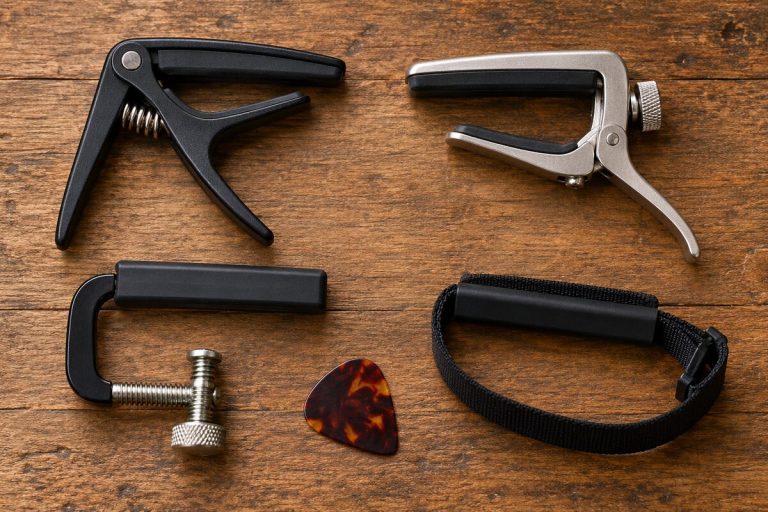
Guide
What Does a Capo Do? A Simple Guide for Guitarists
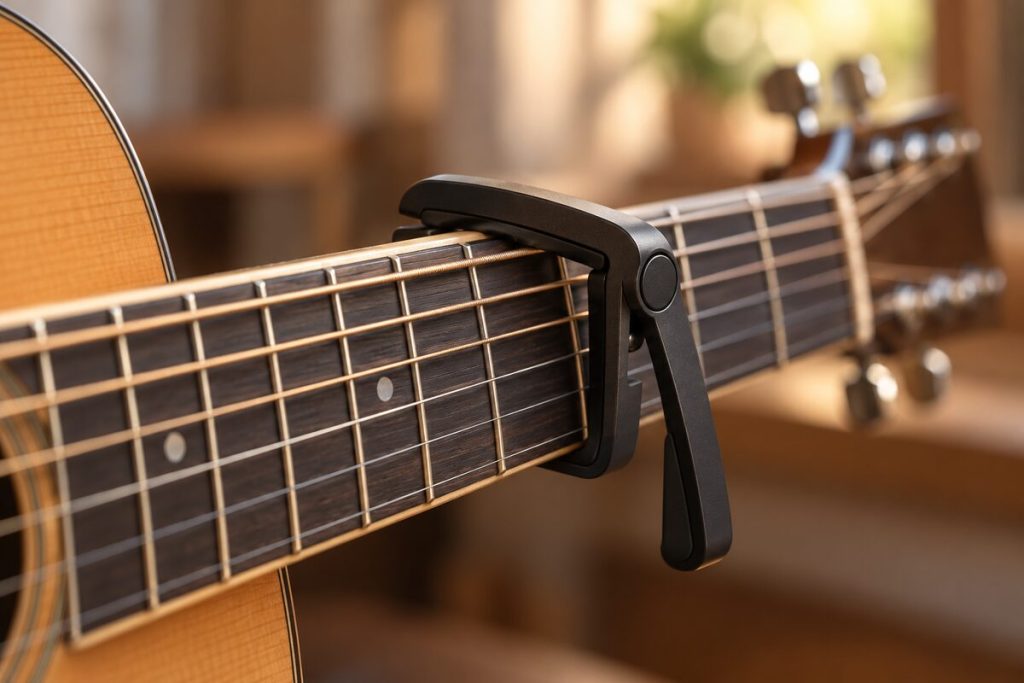
A guitar capo is a small clamp that presses all the strings against one fret. That shortens the part of each string that can vibrate, so every string sounds higher. Each fret you move up raises the pitch by one half step, and the chord shapes you already know stay the same. (This is the music tool, not the Italian word for a boss in a crime family.)
That is the whole job, and it is why almost every acoustic guitarist owns one. Below we cover what the capo does to the strings, why players reach for it, what “capo on the 5th fret” means, whether you actually need one, and which kinds exist.
What a capo does to the strings
Think of the nut, the small grooved strip at the top of the neck. It sets where each string starts to vibrate. When you play an open string, the nut is one end of the vibrating length and the bridge is the other. A capo works as a movable nut. Wikipedia describes it as a device that uses a fret “to create a new nut at a higher note than the instrument’s actual nut.”
Clamp it at the 1st fret and every open string now sounds as if you were fretting that fret on every string at once. The strings are shorter, so they ring higher. The guitar has not been retuned. You have just moved the starting line.
One fret, one half step
On a guitar, “each fret represents one semitone in the standard western system,” as Wikipedia puts it in its article on frets. A semitone is the same thing as a half step, the smallest step on a guitar neck. So the math is simple:
- Capo on the 1st fret: everything sounds one half step higher.
- Capo on the 2nd fret: two half steps higher, which is one whole step.
- Capo on the 3rd fret: three half steps higher, and so on up the neck.
The effect is the same as retuning every string up by the same amount. Wikipedia says so directly: playing with a capo “creates the same musical effect as retuning all strings up the same number of steps.” The difference is that a capo takes a second to put on and a second to take off, and the guitar stays in tune with itself.
What happens to your chords
Your fingers still make the same shapes. The sound changes. A G shape with the capo on the 2nd fret sounds as an A chord. A C shape with the capo on the 2nd fret sounds as a D chord. You think in the shapes you know, and the audience hears the higher key.
Wikipedia gives a neat example. One guitarist plays a progression in E with E, A and B7 shapes and no capo. A second guitarist plays the same progression with the capo on the 4th fret, using C, F and G7 shapes. The two sound the same, but the second player is using much friendlier chords for a beginner. If you want to see this worked out for every common shape and fret, use our capo chart.
Why guitarists use a capo
There are three main reasons, and most players use a capo for at least two of them at once.
Change the key to fit a voice
Songs are written in a key that suits one particular singer. Yours may sit lower or higher. If a song feels too low, you can move it up a half step or two without learning new chords. If you are accompanying someone else, you can raise the key until it sits in the middle of their range, then play along with the shapes you already know.
This is the most common use. The singer says “can we try it a little higher?” and you slide the capo up one fret.
Keep easy open shapes
Open chords such as G, C, D, Em and Am ring out fully because several strings are left open. Barre chords, where one finger lays across all six strings, take more strength and are harder to keep clean. Many songs are written in keys that call for a lot of barre chords on a guitar with no capo.
Put the capo on the right fret and the same song can be played with open shapes. You keep the full, ringing sound of open strings and skip the hand fatigue. For beginners, this is often the difference between playing a song this week and giving up on it.
Brighter sound and playing with a second guitar
Moving up the neck changes the tone as well as the pitch. Shorter strings under the same tension tend to sound brighter and more chimey. A lot of players use that sparkle on purpose, especially on an acoustic guitar.
A capo also helps two guitars sit together. If one player strums low open chords, the second player can capo up and play higher voicings of the same progression. The two parts then occupy different registers instead of fighting for the same space. It is an old trick for making a duo sound bigger.
Capo on the 5th fret: what it means
When a chart or tab says “capo 5” or “capo on the 5th fret,” it means you clamp the capo behind the 5th fret and then play the shapes written in the chart. Count frets from the headstock. The 1st fret is the one closest to the nut, and you place the capo just behind the fret wire, on the nut side, not on top of it.
Five frets is five half steps, so everything sounds five half steps higher than the shapes suggest:
- A G shape sounds as C.
- A C shape sounds as F.
- A D shape sounds as G.
- An E shape sounds as A.
- An A shape sounds as D.
The 5th fret is a popular spot because it turns the common shapes G, C and D into C, F and G, which are exactly the chords many pop and folk songs use. The same logic works for any other fret. Our capo chart lists the key you hear for each shape and fret, and our guide on how to use a capo walks through placing it, step by step.
Do you need a capo?
No. Plenty of great guitarists never touch one, and every song can be played without a capo if you are willing to learn the chords it needs. A capo is a shortcut and a creative tool, not a requirement.
It is worth having if:
- You play along with a singer and need to change keys quickly.
- You want to play songs written with chords that are hard for you.
- You like the brighter sound of a higher position.
You can skip it for now if you mostly play on your own in keys that already suit you, or if you are still learning your first few chords and want your hands to learn the neck properly. A capo will not hurt that learning. It just is not needed on day one.
If you are without a capo and need to play a song in a different key, you have three honest options:
- Learn the barre chord version. It is harder at first and builds hand strength.
- Retune the guitar. This works, but it changes the open strings for every song you play after.
- Transpose the song to a key you can play. A capo does this mechanically; you can also do it by hand with a chart.
Some players grab a pencil, a thick rubber band or a sock to hold the strings down across a fret in a pinch. It rarely holds every string cleanly or keeps the guitar in tune, so treat it as a last resort. A real capo costs little and does the job properly.
Capo types at a glance
You do not need to study every design. Three kinds cover most of what you will see:
- Spring clamp capos. A squeeze handle opens the jaws, and a spring closes them on the neck. They go on and off with one hand, which makes them easy to move between songs.
- Trigger capos. A trigger-style grip lets you clamp and release quickly with one hand while you keep playing. Many players find them the easiest to move mid-song.
- Screw or strap capos. You set the pressure with a screw or an adjustable strap. They take more time to move, but you control exactly how hard they press.
Each design has strengths and trade-offs for different guitars, from acoustic and electric to classical and 12-string. Browse everything in our guitar capos range, or start with the simple basic spring clamp capo if you just want something that works. Not sure which suits your guitar? Our best capos page compares the options.
-

Classic Aluminum Trigger Capo in 7 Colors
Trigger Capos $14.99 1,000+ sold worldwideChoose a color This product has multiple variants. The options may be chosen on the product page -

Aluminum Trigger Capo with Silicone Pads, 7 Colors
Trigger Capos $17.99 100+ sold worldwideChoose a color This product has multiple variants. The options may be chosen on the product page -
Plastic Guitar Capo with Bridge Pin Puller
Spring Clamp Capos $17.99 500+ sold worldwideChoose a color This product has multiple variants. The options may be chosen on the product page


Frequently asked questions
If you do not have a capo, you can play the barre chord version of the song, retune the guitar, or transpose the song into a key that suits the chords you know. Some players hold the strings across a fret with a pencil and a rubber band, but it rarely stays clean or in tune. For regular use, a real capo is cheap and far more reliable.
It means you clamp the capo behind the 5th fret and play the chord shapes as written. Five frets equal five half steps, so the song sounds five half steps higher than the shapes. For example, a G shape sounds as C, and a C shape sounds as F.
Yes, for most players. It lets you change the key in seconds, keep easy open chord shapes in difficult keys, and get a brighter sound. It is not required, and you can learn guitar without one, but it is a very useful and inexpensive tool.
The main types are spring clamp, trigger, and screw or strap capos. They all shorten the strings the same way and differ in how you attach them and how quickly you can move them. See our guide to capo types for a full comparison, or browse our guitar capos.